
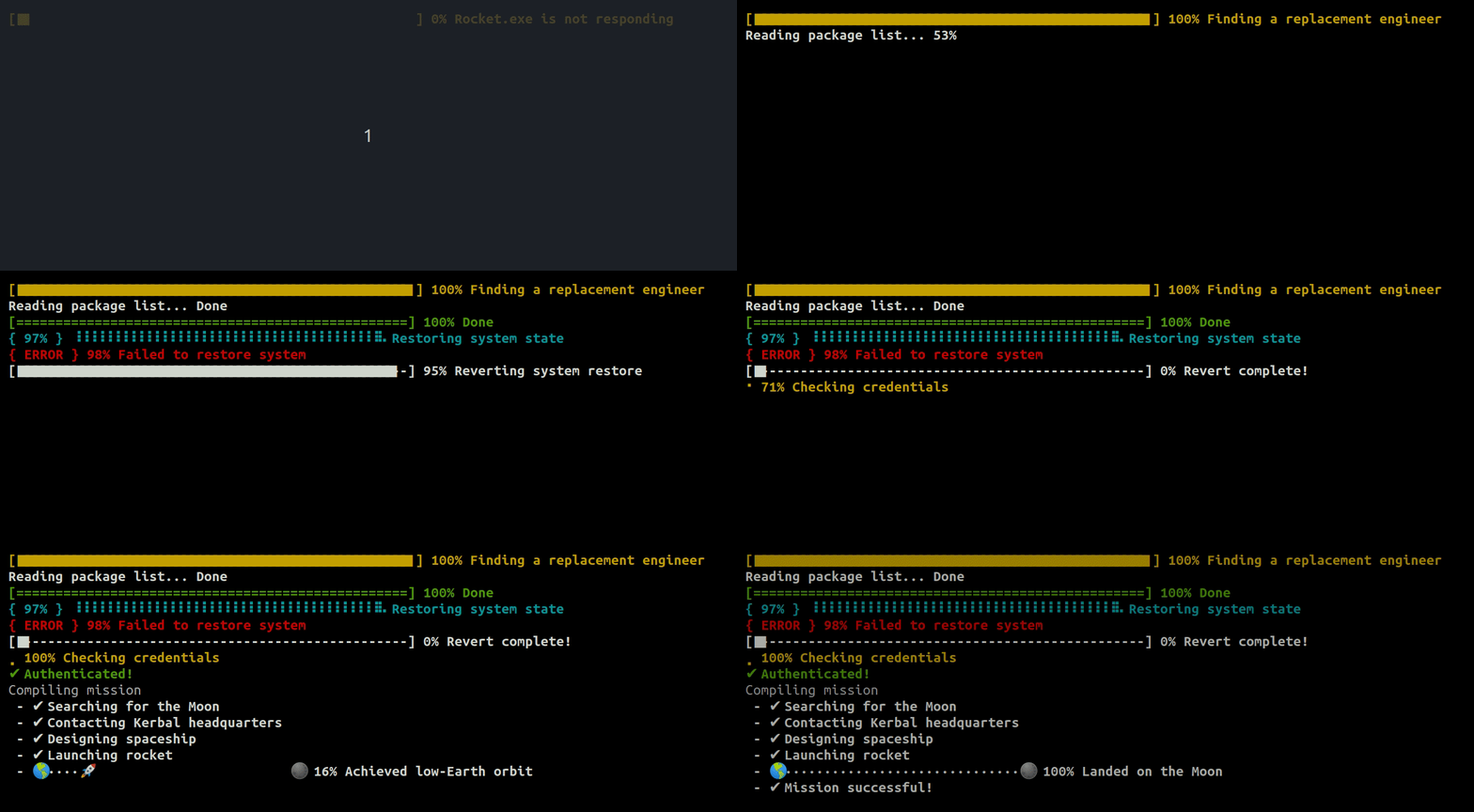
# Progress bar
To introduce a progress bar in your application, include `indica/progress_bar.hpp` and create a `ProgressBar` object.
```cpp
#include
int main() {
indica::ProgressBar bar;
return 0;
}
```
Here's the general structure of a progress bar:
```
^^^^^^^^^^^^^^^^^^ Bar Width ^^^^^^^^^^^^^^^^^^ ^^^^^ Show/Hide ^^^^^
```
Each of these elements (and more) can be configured using the ProgressBar API:
```cpp
#include
int main() {
indica::ProgressBar bar;
// Configure the bar
bar.set_bar_width(50);
bar.start_bar_with("[");
bar.fill_bar_progress_with("=");
bar.lead_bar_progress_with(">");
bar.fill_bar_remainder_with(" ");
bar.end_bar_with("]");
bar.set_postfix_text("Getting started");
bar.set_foreground_color(indica::Color::GREEN);
return 0;
}
```
Now that the bar is configured, let's update the state of the bar. The amount of progress in ProgressBar is maintained as a float in range `[0, 100]`. When progress reaches 100, the progression is complete.
From application-level code, there are two ways in which you can update this progress:
## Update progress using `tick()`
You can update the progress bar using `bar.tick()` which increments progress by exactly `1%`.
```cpp
#include
#include
#include
int main() {
indica::ProgressBar bar;
// Configure the bar
bar.set_bar_width(50);
bar.start_bar_with("[");
bar.fill_bar_progress_with("=");
bar.lead_bar_progress_with(">");
bar.fill_bar_remainder_with(" ");
bar.end_bar_with("]");
bar.set_postfix_text("Getting started");
bar.set_foreground_color(indica::Color::GREEN);
// Update bar state
while (true) {
bar.tick();
if (bar.is_completed())
break;
std::this_thread::sleep_for(std::chrono::milliseconds(100));
}
return 0;
}
```
The above code will print a progress bar that goes from 0 to 100% at the rate of 1% every 100 ms.
## Updating progress using `bar.set_progress(value)`
If you'd rather control progress of the bar in discrete steps, consider using `bar.set_progress(value)`. Example:
```cpp
#include
#include
#include
int main() {
indica::ProgressBar bar;
// Configure the bar
bar.set_bar_width(50);
bar.start_bar_with("[");
bar.fill_bar_progress_with("=");
bar.lead_bar_progress_with(">");
bar.fill_bar_remainder_with(" ");
bar.end_bar_with("]");
bar.set_postfix_text("Getting started");
bar.set_foreground_color(indica::Color::GREEN);
// Update bar state
size_t i = 0;
while (i < 101) {
bar.set_progress(i);
std::this_thread::sleep_for(std::chrono::milliseconds(100));
i += 10;
}
return 0;
}
```
The above code will print a progress bar that goes from 0 to 100% at the rate of 10% every 100 ms.
## Multi-threaded Example
```cpp
#include
#include
int main() {
indica::ProgressBar bar;
bar.set_bar_width(50);
bar.start_bar_with("[");
bar.fill_bar_progress_with("■");
bar.lead_bar_progress_with("■");
bar.fill_bar_remainder_with("-");
bar.end_bar_with("]");
bar.set_foreground_color(indica::Color::YELLOW);
// As configured, the bar will look like this:
//
// [■■■■■■■■■■■■■■■■■■■■■■■■■■■■■■■■■■■-------------] 70%
//
//
std::atomic index{0};
std::vector status_text =
{
"Rocket.exe is not responding",
"Finding a replacement engineer",
"Buying more snacks",
"Assimilating the modding community",
"Crossing fingers",
"Porting KSP to a Nokia 3310"
};
// Let's say you want to append some status text to the right of the progress bar
// You can use bar.set_postfix_text(...) to append text to the right
//
// [■■■■■■■■■■■■■■■■■■■■■■■■■■■■■■■■■■■-------------] 70% Finding a replacement engineer
// ^^^^^^^^^^^^^^^^^^^^^^^^^^^^^^
//
//
auto job = [&bar, &index, &status_text]() {
while (true) {
if (bar.is_completed()) {
break;
}
bar.set_postfix_text(status_text[index % status_text.size()]);
bar.tick();
index += 1;
std::this_thread::sleep_for(std::chrono::milliseconds(200));
}
};
std::thread first_job(job);
std::thread second_job(job);
std::thread third_job(job);
std::thread last_job(job);
first_job.join();
second_job.join();
third_job.join();
last_job.join();
return 0;
}
```
For more examples, checkout the examples in the `samples/` directory.